Friday, February 18, 2022

The Spatial Gaze

 "Gaze is the act of seeing; it is an act of selective perception. Much of what we see is shaped by our experiences, and our "gaze" has a direct bearing on what we think. And what we see and think, to take the process one step further, has a bearing upon what we say and what and how we write ."

--Paul Stoller


Spatial gaze is the fieldworker's stance and worldview. In the field we must do the following things to give comprehensive attention and description to the importance of space:
  • how to look at your fieldsite
  • detailing and mapping space
  • finding unity and tension within a place
    • tension is revealed in the moments of contradiction when multiple or opposing perspectives collide
  • locating a focal point (finding a perspective from which to describe your fieldsite)
Personal Geographies (sense of place) influence our spatial gaze, how we look.
  • factors influencing gaze may not always be in our awareness
  • (Jamica Kincaid's writing in text)-enormous influence of English culture on her growing up and gaze in Jamaica
Selective Perception
  • letting your eye rest on things locals do (as insiders)
  • methods
    • outside to inside: begin with a large, sweeping description of the fieldsite landscape and move inside to important details you will "rest" on.
    • questions which reveal selective perception (ethnocentric gaze):
      • why do i focus on this element and not that?
      • what is my reason for narrowing my gaze to any specific place?
      • what spaces have i rejected when narrowing?
      • Why do i use the metaphors and descriptions that i do?
      • which metaphors and descriptives did i abandon as inappropriate?
      • where in my fieldnotes do i find evidence for this description?
      • what have i rejected and why?
    • dont rely only on visual cues:
      • sound
      • tastes
      • textures
      • smells
      • light, shapes, time, season, weather, atmosphere, etc.
Writing about perceptions
    • Nouns
      • a focal point is often a noun that recurs, provides a starting point for understanding the fieldsite, provides a metaphor (acts as a generalizing symbol) for your fieldsite. 
      • a place from which you might logically elaborate on your fieldsite (tell its story)
      • ex: NY Ave. as the nexus of gay culture (even though the gay section of AC was the area surrounding NY Ave.)
      • look for vocabulary specific to your fieldsite
    • Verbs
      • bring action to your fieldsite
      • look for exactly the right verbs to describe the activities taking place
      • look for precision and active voice
      • so, use ACTIVE (not passive) verbs
    • Adjectives and adverbs
      • cultural assumptions can hide inside adjectives and adverbs!
        • qualifying words contain value judgements and are not verifiable
        • leave most of them out and just describe what you see, hear, taste, smell...through your SENSES rather than draw conclusions
    Colonized spaces:
    • when people inhabit spaces over which they have no control.
    • when researchers don't adopt the informants perspective
    • when researchers write about a culture from their own privileged gaze, 
    • when ethnographers fail to use the informants voice in the writing process
      • seen in situations of urban blight
      • seen in situations of gentrification

    More Tips for Thick Description and STUDENT EXAMPLES

      Tips for Writing Thick Descriptions for Ethnographies and Case Studies 

    EXAMPLES ON ETHNOGRAPHIC STUDENT WRITING


    DESCRIPTION------------------------NARRATIVE-----------------------------ANALYSIS


    Ethnographies pose unique challenges, because they involve a combination of fieldwork (observation, interview, survey) and critical analysis through the application of core disciplinary or course concepts. 

    • Your thick description of behaviors in their context should try to paint a clear picture of the event, situation, environment, or culture in question. 
      • If possible, bring a notepad and/or tape recorder in order to capture small details. If you cannot take notes while observing, be sure to write your thoughts down as soon after the experience as possible. 
      • It is also extremely important to be self-reflective; notice how your presence might alter the environment, as well as how your own assumptions and reactions to the situation might affect what you notice and how you write about it. 
      • spend adequate time observing and be a skillful observer. Consider questions like the following: 
        • + What is the layout of the space or room? 
        • + What are the specific objects or physical elements in the space? 
        • + Who are the people involved? 
        • + What clues signify people’s statuses and roles? 
        • + What are the people you are observing doing in general or attempting to accomplish? 
        • + What explicit structures, rules, or norms govern the situation? 
        • + What are people wearing? 
        • + What is their affect like? 
        • + How do people interact with one another? 
        • + What are individuals’ specific behaviors, both verbal and non-verbal? 
      • When composing your thick description of events, try to show rather than tell by using evocative language. (Put another way, select words that help the reader see what is being described). 
        • Try to be as specific as possible by avoiding general or abstract words. 
        • Instead, use anecdotes, examples, descriptions, and quotations to make your experience concrete for the reader. 
      • Taking Good Notes in the Field Before beginning your observation, interview, survey, or other fieldwork
        • Identify your own ideas and expectations about the situation. Being aware of these will help you as you observe, allowing you to collect data more neutrally, instead of fitting the data to match your expectations. 
        • below are sentences that could be in an essay; however, they are not good formulations for your observation notes because they move too quickly from observation to conclusion. Before you make judgments, give analysis, and draw conclusions, you need careful details. Notes of your observations or direct quotes from surveys and interviews make up the evidence needed for the final analysis. 
    Too Vague Descriptive 

    “Coach Rodriguez was my favorite.”   (instead)        

    “Coach Rodriquez was the only coach who spent 30 minutes working one-on-one with each athlete every week.” 

    “The chair of the meeting was ineffective.”  (instead)

    “The chair addressed only 3 of 5 points on the agenda in the 60 minutes allotted for the meeting.” 

    Too Conclusive Detailed 

    “The teacher likes the students.”  (instead)

    “The teacher smiles when the students enter the room, greets them attentively and warmly, and hugs those that run to her.” 

    “The interviewee was uncomfortable with" (instead)

    “During questions 5 thru 7 the interviewee started this line of questioning.” fidgeting in his seat, touching his hand to his mouth, and speaking more slowly while clearing his throat repeatedly. He displayed none of those behaviors in the first 4 questions.” 

    Stating what COULD be Explaining what IS happening 

    “Students will learn math better with hands- (instead)

    “Yesterday, when the teacher wrote problems on the board on examples than numbers on a chalkboard.” 3 students answered all problems correctly. Today, when the teacher used blocks and bottle caps, 8 students answered most problems correctly in under 30 seconds.”


    EXAMPLES

    (1) As we approached the steps down from the footbridge which had taken us over the railway line we looked down at people eating and drinking in the garden of the public house which was part of the business that Diane and I were currently studying. Tynemill, a business running a couple of dozen pubs and bars, had moved its base to the upper floor of The Victoria, a late nineteenth century former railway hotel. We entered The Vic and, after pushing our way through the group of customers who were crowding the main bar, found ourselves being greeted by Neil, a director of Tynemill who was currently spending most of his time in The Victoria and, it would seem, taking charge of activities in the pub. ‘Perhaps you ought to get round this side of the bar and help us out’, he suggested to Diane, who had learned how to serve pints, take food orders and all the rest at this bar as part of the ‘ethnographic fieldwork’ component of the Tynemill study. Neil looked a little more askance at Tony, ‘Fancy seeing you here, stranger’. ‘Yes, it’s no good asking me to help out, Neil. I’d be no better that side of the bar than I am at this’. Neil rolled his eyes upward, jokingly acknowledging his awareness of Tony’s well-known discomfort at struggling to get served at crowded bars. But he was also aware, from earlier conversations, that Tony tended to associate going into The Victoria with some unhappy experiences when he was working as a participant observer in the large company across the railway line. These were experiences of ‘going for a goodbye drink’ with managerial colleagues who had found themselves made redundant by the company to which they had given years of highly committed service.Yet, as Neil had pointed out on an earlier occasion, The Victoria in pre-Tynemill times was a ‘very different place’. ‘The Vic, as it was then’, Neil had argued, was ‘precisely what Tynemill had come into existence to provide an alternative to. It had been a scruffy, unwelcoming dump offering one brand of keg beer (imposed on it by the brewery) and two flavours of crisps if you were lucky’. ‘But look what you’ve got now’, he went on.‘There’s a proper choice of real ales, bottled beers and excellent wines. You’ve got full food menus in the bar and the restaurant. And you’ve got the chance of good conversation, without jukeboxes or the bridge games machines. And all of this is in a comfortable physical environment, inside or out in the garden, without any kind of pretentiousness …’ ‘Except perhaps on the part of some of the regulars who tend to block the bar,’ interrupted Tony, ‘and some of the old brewery posters are a bit …’. ‘Well, if you came in here a bit more often …’, Neil started to respond before being called away to deal with a problem that had arisen in the kitchen, an area of his territory that he was especially proud to rule over. ‘I’d better go and see what’s happening in the kitchen’, Neil explained, ‘and I’m expecting to see Chris at any time now. We’ve some rather big things to discuss’. With Neil away in his beloved kitchen, Tasha came over and served us with our pint of Hemlock (brewed in Tynemill’s own Castle Rock brewery) and a glass of red wine. Diane and Tasha had a quick conversation about recent developments among the Victoria’s bar staff but nothing was said about what the issues might be that Neil was going to be discussing with Chris, the managing director of Tynemill. This was something we would need to find out about later. Meanwhile, however, we took our drinks over to the only empty table, one which was next to the door of the bar. This was a slightly uncomfortable place to sit but, as Diane pointed out, it provided to the still uneasy Tony, quite a good vantage point for people who took their ethnographic research seriously. Suitably chastized, Tony sipped his Hemlock and turned to see how the customers who had newly arrived in the pub were managing to navigate through the now even more crowded space in front of the bar.


    (2) The taxi turns right out of the honking traffic through the main gate set within a forbidding, three-metre-high, spiked wrought iron fence. 1 The taxi driver jokingly asks us, in English, whether the fence is there to keep students in, or others out.Students mill about in the yard, between the fence and the dull grey concrete buildings. They are nearly all female, and there seem to be two styles of dress. Some wear very short skirts or tight jeans, sweaters, shirts, boots and long hair. In contrast to this there are some in Islamic dress, their hair and head fully covered by the hijab or scarf and only the skin of the face and hands visible. We enter the main door, and are greeted by the caretakers, all brown-suited middle-aged men with moustaches, leaning against grey unadorned walls. We pass the student common room and tobacco smoke billows from the door.We walk along a tile-floored corridor past a large black bust of Atatürk, a Turkish National flag, tall glass cabinets with examples of costume and embroidery, and continue onto a grimy stone floor, passing hundreds of students along the way. Glancing right we see a ‘kitchen’ lined with large steaming urns of boiling water. In here there are five or six middle-aged men in blue overall jackets making glasses of tea and coffee and carrying them away, one handed, on silvery metal trays. We walk up a wide uncarpeted staircase, into the main administration and management area where the floor is carpeted and each office door has a brass plate with the occupant’s name and title. Each of the offices has an outer office with a secretary. 2 As we enter the Vice-Dean’s rooms her secretary, a woman in her forties wearing a dark skirt and white blouse, welcomes us with a formal and deferential ‘Guneydin’, shakes our hands and shows us into the main office. The room is about four metres square, with a blue/grey plain carpet, high windows across one wall and a piece of flat modern sculpture on the wall opposite.There is a large, very tidy, dark wooden desk. Everything on it is neatly arranged including pens, pencil, scissors, a jar of sweets, a television remote control, and two telephones.At the front of the desk is a black ceramic nameplate with ‘Prof. Dr -------’ in gold lettering. The desk has a padded black leather chair behind it. On the right of the chair is a Turkish flag furled on a pole topped by a golden crescent. Next to the flag there is a blue and white circular enamel charm against the evil eye. On the wall directly above the chair is a severe black and white portrait of Atatürk looking down into the room. An IBM computer sits on a small table to the left of the desk, and behind this a television. There are three houseplants in the corner, two armchairs facing each other across a low coffee table, on which there is a notepad from Manchester Museum of Science and Industry and a prospectus from Purdue University. The inside of the office door is covered in quilted leather padding. The secretary, through our interpreter, apologizes for the absence of the Vice-Dean, giving us a choice of tea, apple tea, coffee, or a herbal sage drink. We order apple tea and sit waiting. After about five minutes the Vice-Dean arrives, breathlessly explaining that she had been to a meeting to substitute for the Dean who was ill. She is wearing a blue and black striped suit, a white sweater and we notice a small gold Atatürk’s-Head lapel badge. She sits behind her desk under the portrait of Mustafa Kemal and immediately telephones her secretary to order more refreshments.

    ___________

    More on descriptive writing:

    Show don’t tell, and including sensory detail from our five senses helps us drop the reader into our ethnographic world.  

    Sight
    The most often used sense when writing is sight. It’s what we use most and what comes naturally to us-write about what you see. 

    • But here’s a tip: Look beyond what others see-blue sky, green grass-to the details of color, shape, size, to indicate something new. For example, “The shamrock green of the open expanse curved around a small grove of trees then down toward the river.”

    Hearing
    Loud, soft, yell, whisper, angry, and all kinds of other adjectives are used for sound. But have you thought about using something more personal? “She spoke with a lover’s voice, not a cat’s, making me want to listen closely to every syllable.” Or, “He sounded like freedom. Not just his words, but the way they tumbled gently from his lips.” Or use a little synesthesia: “It was a bright red noise, repeating stop, stop, stop continually, until I couldn’t go on any longer.”

    • this may seem like creative writing and it is...don't go to far afield, but metaphors are okd

    Smell
    Smell is another one of those senses that’s different for each of us. What I think is a bad smell, someone else might not be bothered by it. So, works like stink and pungent are great to use, but you can easily go deeper into explanation. For example, “The alley smelled of urine and Cracker-Jacks, an assault to the nose and eyes alike.” Or how about this: “The wind changed to something foul, dead, wafting up from the darkened pit.”

    Touch
    The way things feel is more than just texture and temperature. Like the other senses, it can be personal: “His handshake was my father’s handshake, not to meet you, but the rough callousness of someone showing you who’s boss.” Or try something like this: “It felt like the memory of something long forgotten, thin, almost invisible.”

    Taste
    Taste is something that is different to each of us and is difficult to get across . Yes, we all know what bacon tastes like if we just say it tastes like bacon, but what about doing something unique with that idea? If you think about it, taste is more than just something your brain interprets from your taste-buds. It’s texture and smell and sight and even process, all mixed together. Try this: “The undercooked bacon felt like a wet sponge placed on my tongue, only grease leaked into my mouth instead of water.” Or this: “I could smell the mold even before I put the cheese into my mouth.” Of course, you can always use a metaphor or simile, like, “Like hot cocoa on a winter morning, the dinner calmed and relaxed me.”

    Of course, you can always use the senses in your writing just to “explain,” in which perhaps you want to be straightforward and use familiar language, but when you have all these other tools, you’ll want to select how you approach the five senses. As mentioned and illustrated in the example, the senses overlap to a point where we often pitch them together as a way of explaining just one of them. 

    Monday, February 14, 2022

    Ethics and The Study of Culture

     Ethics is a branch of philosophy that addresses questions of morality; ‘right’ and ‘wrong’.  

    • The heart of ethics lies in the notion that every action generates a cause,  or consequence. Consequentialism is the idea that the consequences of a particular action form the basis for any valid moral judgment about that action, regardless of the actors intentions (Anscombe 1958). 
    • Ethics is a central concern in the field of anthropology because anthropological research investigates humans and the methods, results and conclusions produced by anthropological research can have a direct effect on living populations.  
    • When designing a research project, the anthropologist, as the actor, must determine the potential consequences of the research action as well as the positive and negative outcomes that can emerge.
    • Part of the challenge in making ethical decisions is the fact that anthropology has always been an activist discipline. 
      • E. B. Tylor claimed that, “the science of culture is essentially a reformer’s science” 
      • Ruth Benedict said that the “purpose of anthropology was to make the world safe for human difference.” 
      • John Bodley has been quoted saying that anthropology is a subversive science. So where do anthropologists draw the line between cultural relativism and intervention? 
    • Cultural relativism is the idea that traits can only be understood within their cultural context. If we consider cultural relativism on a spectrum, then one extreme holds that all traits good within their cultural context…
      • as stated by Conrad Kottak in Mirror for Humanity…Nazi Germany would be evaluated as nonjudgmentally as Athenian Greece using this extreme. 
    • On the other end there is the idea that there is no way to be truly culturally relative because we are all human beings with cultural baggage—have ideas about what are right and wrong. 
      • Robert Reed, a former professor at The Ohio State University once said that we can be culturally relative and still disagree with a behavior if, and this is an important if, if you try to understand why that behavior exists in the group. In other words, why do people practice the behavior.
    • A big question that every cultural anthropologist has to think about is this: What do you do if intervention could change the culture? Is that our role as researchers? Most anthropologists would say that it isn’t our job to change things; however that doesn’t mean we can’t give people information that they can use as they will.
    • Another question that cultural anthropologists face is what to do when a cultural trait interferes with an individual’s human rights? Where is the ethical line in that situation? 
    • Perhaps one of the most critical ethical debates in anthropology in general is that of informed consent
      • Informed consent includes the “…full disclosure of research goals, research methods, types of analyses, and reporting procedures” (Bonvillain 2010: 62). In April 2010, the New York Times ran an article about alleged misuse of DNA samples collected from the Havasupi tribe in 1990. This article highlights the issue of informed consent.

    The American Anthropological Association (AAA) is a professional association for anthropologists in the United States, and part of the mission of the  AAA is to help educate members about the ethical obligations and challenges associated with anthropological research. 

    AAA is committed to helping all anthropologists have access to quality information regarding methodological and ethical best practices. The Association’s Principles of Professional Responsibility include:

    1. Do No Harm
    2. Be Open and Honest Regarding Your Work
    3. Obtain Informed Consent and Necessary Permissions
    4. Weigh Competing Ethical Obligations Due Collaborators and Affected Parties
    5. Make Your Results Accessible
    6. Protect and Preserve Your Records
    7. Maintain Respectful and Ethical Professional Relationships

    • The organization offers ethical guidelines as a ‘Code of Ethics‘ by which all members are expected to abide. 
    • Contemporary concerns over the consequences of anthropological research and findings are rooted in the history of the discipline as a tool for domination and oppression of marginalized people. 
      • During the colonial era, for example, anthropologists helped produce evolutionary models and pejorative representations that served to justify the exploitation and occupation of indigenous people. 
      • In some cases, anthropological research has been used to justify genocide, such as the Eugenics Movement in the United States and the Holocaust in Germany. We will explore this in greater detail when we discuss Colonialism in the second module and Race in Anthropology in the third module. 
      • The American Anthropological Association has a number of real ethical dilemmas posted on their web site. These posts also include comments by other anthropologists— sometimes agreeing with the researchers decision and sometimes not. It’s interesting information and I urge you to take a look at a couple of the cases.

    Human Experimentation

    Human Experimentation, or Human Subject Research, is a systematic investigation that involves the use of human subjects in any capacity.  This includes the collection and analysis of behavioral and psychological data as well as biological specimens. Human Subject Research is tightly regulated because research processes and conclusions can generate impacts on study participants and communities.

    The Migram Experiment: Obedience to Authority

    • One famous example is the social-psychological ‘Obedience to Authority’ experiment conducted by Stanley Milgram at Yale University in the 1960s. During a time when Nazi war criminals were being held on trial for their involvement in the atrocities committed during the Holocaust, Milgram questioned if everyday people would violate their deepest moral convictions when following orders by an authority figure. In his experiment, participants were led to believe that they were administering an electric shock when someone answered a question incorrectly. Several of the participants in his study continued to administer the electric shock, in what they believed to be in lethal doses, as they followed the orders of an ‘authority.’ After participating in the project, many participants experienced adverse psychological effects resulting from stress induced by the research procedures as well as the finding generated from the data collected by the researchers.
    • The Stanford Prison Experiment: 
    In a similar study in the 1970s, psychology professor Philip Zimbardo at Stanford University questioned the cause of abusive behavior by prisoners and prison guards. He aimed to discover if there was something inherent in the individual that compels them to engage in abusive acts, or is it the conditions in prison that elicit such behaviors.  Watch the documentary below consider the objectives and impacts  of the Milgram and Stanford experiments on human subjects.


    Undisclosed Human Experimentation

    Although participants in the Milgram and Stanford experiments were not fully informed of the research process, they were aware that they were participating in a research study. There have been numerous cases of research and experimentation on human subjects who were unaware that they were participating in a study. 
    • In most cases, the research subjects were  members of marginalized populations such as racial minorities, prisoners, poor, people with disabilities, institutionalized, and children. Some of the most notable violations of human rights has taken place in the field of biomedical research.

    The Tuskegee Experiment

    The U.S. Public Health Service conducted the Tuskeegee Syphilis experiment to study the natural progression of untreated syphilis over an extended period of time. The study took place in Alabama from 1932 until 1972, over forty years. 
    • Information, such as blood samples,  were collected from more than 600 poor African-American males who were led to believe that they were receiving free health care from the U.S. government. Nearly 400 of the participants had previously contracted syphilis; yet they were never told they had the disease, nor were they treated for it when Penicillin became widely available as a cure during the 1940s (http://www.cdc.gov/tuskegee/index.html).
    • In 2010, the American public became aware that similar studies took place in the 1940s in areas such as Guatamala where prisoners and soldiers were deliberately infected with the disease in order for American doctors to test the effects of penicillin on the disease. To review an extensive list of well-known human experiments in the United States, visit the Unethical Human Experiments webpage on wikipedia.org.). As a result of the human rights violations that took place during the Tuskegee Experiment and others, contemporary research involving human subjects must be reviewed by an Institutional Review Board (IRB)
    Informed consent requires that the participants in the study are fully informed of  the purpose, procedures and potential consequences of their participation.  
    • To work in a community, anthropologists are required to inform local officials and residents about the purpose of their research and the sources of their funding. People who agree to participate in the research must be informed of the purpose , nature and procedures of the research as well as the potential costs and benefits of participation. 
    • In order to obtain informed consent, research participants must be capable of fully understanding the process and communicating their consent. For information regarding the IRB process and informed consent at the University of North Florida, visit the UNF IRB website .

    Anthropological research requires informed consent because it can generate consequences for residents and the research community. 

    When anthropologists interact and engage with people for the purposes of research, they can generate unintended consequences for the communities they are working with. 
    • Information collected by anthropologists can be used against the community they study, or personal data about specific individuals can result in social marginalization or persecution. 
    • Anthropological research can therefore induce a wide-range of ethical implications, but here we will focus on three specific areas: the impact of presence, methods, and anthropology in military.

    Impact of Presence

    The nature of anthropological research involves close interaction with people, and the presence of the anthropologist as well as the information generated by anthropological research can create unintended impacts on the community.
    • The HBO documentary ‘Secrets of the Tribe’ addresses the tenuous relationship between the Yanomami people of Venzuela and the famous anthropologist, Napolean Chagnon who labelled them ‘The Fierce People’ and characterized the tribes as violent and savage. 
    • Some critics have argued that research results and conclusions produced by anthropologists, such as Chagnon, have been used to alienate, exploit and/or exterminate individuals and groups.
    • Since anthropologists are people too, it is not unusual for a cultural anthropologist to develop close relationships, including friendships and even romantic encounters, with members of the community during long-term fieldwork.


    A student of Napolean Chagnon, Kenneth Good, married a 15-year old member of the Yanomami tribe, Yarima, while conducting fieldwork in her community. They later relocated to Gainesville, Florida while Goode worked as a professor of Anthropology at he University of Florida. 

    • National Geographic critically portrayed the interpersonal dynamics between the couple in the documentary, Yanomami Homecoming. 
    • Good later published his memoirs about their relationship in his book, Into the Heart. After two children, Yarima left the U.S to return to her village and Good did not enable her to see her children. 
    • Twenty years later, in 2013, her son left for the Amazon to find his mother. BBC News documented their reunion is their story, ‘Return to the Amazon: A son’s search for his amazonian mother.’  The ethical debate surrounding Good’s marriage to a minor has been a heated debate controversy among anthropologists for many decades.

    Research Methods

    The type of method used can influence findings from the research and generate impacts on participants. The Milgram Experiment and the Stanford Prison Experiment offer an example of the ways that research methods can induce psychological impacts on participants. The Tuskegee Experiment offers an example of the ways that research can generate bio-medical impacts on research participants.

    Anthropology and the Military

    The U.S. military has historically relied on anthropological research as part of both offensive and defensive military strategies. As a result of the high unemployment rates and educational cutbacks that have come to characterize the academic job market in the 21st century, many American anthropologists are seeking employment opportunities as cultural experts for military operations, private military contractors, and the U.S. Department of Defense. 
    • This has generated a significant amount of controversy among contemporary anthropologists who perceive of anthropology as a humanitarian discipline and oppose such activities .  
    • In 2007 , a group of anthropologists organized the ‘Network of Concerned Anthropologists’ which opposes the use of anthropological research for counter-insurgency activities.


    Thursday, February 10, 2022

    Ethnographic Interviews and Transcription


    What is an ethnographic interview?

    Science is a practice (the loop)

    So what does one ask in an interview?

    Building rapport while asking questions

    • Are they messy (and sometimes even stressful)? Absolutely. But this is the most ethically correct and effective way to run an interview at present.


    Creating Interview Questions
    • prioritize questions
    • throw out questions that do not serve your scope of research (there is always another project!)
    • semi-structured interview still allows for informants to talk and keep talking until they are finished
    • allow informants to speak until they are finished
    • follow up with questions which get informants to elaborate on their previous answer (this requires that you listen and think about what they are saying)
    • only move on when you have exhausted the scope of the informant's answer
    • transcribe your notes

    Interviews allow you to close the gap between what "informants say they do" and "what they do".
    • emic presentation: the meanings people give to their actions and the world around them form an essential component of understanding.
    • informants can be eloquent communicators about their culture
    • information on secret histories, internal power struggles, unofficial customs
    • an opportunity for private discussion that can reveal beliefs and opinions difficult to access otherwise (things people will only discuss in a one on one interview)
    Learning to Listen:
    • good way to enter a fieldsite, gain trust, and gather basic information
    • developing trust and rapport or build a deeper connection
    • prompting in-depth responses
    • ask for information about others and possible leads
    • reveal cultural logics or conflicting reports reveal different meanings or contested meanings within the culture
      • different versions reveal the ways that individuals vary within the collective
    • ask informants if they have any questions for you at the close of an interview, or "what else should I know?" 
    Textual Listening
      • virtual worlds may be textual rather than auditory with fewer conversational cues like tone, volume, inflection, posture, or gaze
        • harder to determine who is speaking to whom or nuances of meaning
        • fast typing skills are needed
        • may be multiple conversations going on
        • choose closed session interviews like zoom or skype or messenger or facetime or google rooms
    Group Interviews:
    • create new social situations and can be held to ask group questions
    • help each other with prompting and recall
    • eases awkwardness
    • allow for comparison
    • minimize observers bias
    • see how cultural values and social relations become apparent through conversation and interaction
    • collect and correct memories to create oral histories
    • be attentive to relationships and inequality between participants
    • better if they already know each other (me)
    • ethnographer is facilitators making sure everyone can speak
      • ask quiet participant to respond directly
    Transcription
    • do it as quickly as you can after your interviews so you can note nonverbal observations---take notes on this during interview if possible (i note time on recorder)
    • word-for-word is best
    • 4:1 (double if translating)
    • ensure anonymity
    • how to handle things like... (may reveal emotional content)
      • hesitations (.)
      • pauses  short or (2.5) time of pause
      • laughter (laughter)
      • unintelligible words xxxx
    • video is better than audio

    Tips on Transcription Practices for Linguistic Anthropological Analyses

    Some considerations on transcription from Alessandro Duranti's Transcription: From Writing to Digitized Images:

    We must keep in mind that a transcript of a conversation is not the same thing as the conversation; just as an audio or video recording of an interaction is not the same as the interaction. But the systematic inscription of verbal, gestural, and spatio-temporal dimensions of interactions can open new windows on our understanding of how human beings use talk and other tools in their daily interactions." (Duranti, 1999, p. 161)

    A transcript is a technique for the fixing (e.g. on paper, on a computer screen) of fleeting events (e.g. utterances, gestures) for the purpose of detailed analysis.Transcripts are inherently incomplete and should be continuously revised to display features of an interaction that have been illuminated by a particular analysis and allow for new insights that might lead to a new analysis. (See Alessandro Duranti Linguistic Anthropology, Cambridge University Press, 1997: ch. 5)

    There are different kinds of transcripts. Some transcripts are designed to only represent talk. Other ones try to integrate information about talk and gestures. Some other ones might focus exclusively on non-verbal interaction. Linguistic ethnographers often produce an annotated transcript, that is, a text where the representation of talk is enriched by contextual information that is relevant to talk or makes it meaningful.

    Duranti's main points:

    (i) transcription is a selective process, aimed at highlighting certain aspects of the interaction for specific research goals;

    (ii) there is no perfect transcript in the sense of a transcript that can fully recapture the total experience of being in the original situation, but there are better transcripts, that is, transcripts that represent information in ways that are (more) consistent with our descriptive and theoretical goals;

    (iii) there is no final transcription, only different, revised versions of a transcript for a particular purpose, for a particular audience;

    (iv) transcripts are analytical products; that must be continuously updated and compared with the material out of which they were produced (one should never grow tired of going back to an audio tape or video tape and checking whether the existing transcript of the tape conforms to our present standards and theoretical goals);

    (v) we should be as explicit as possible about the choices we make in representing information on a page (or on a screen);

    (v1) transcription formats vary and must be evaluated vis-a-vis the goals they must fulfil;

    (vii) we must be critically aware of the theoretical, political and ethical implications of our transcription process and the final products resulting from it;

    (viii) as we gain access to tools that allow us to integrate visual and verbal information, we must compare the result of these new transcription formats with former ones and evaluate their features;

    (ix) transcription changes over time because our goals change and our understanding changes (hopefully becomes "thicker,") that is, with more layers of signification.
     

    From Marcyliena Morgan's book Speech Communities, p. 94
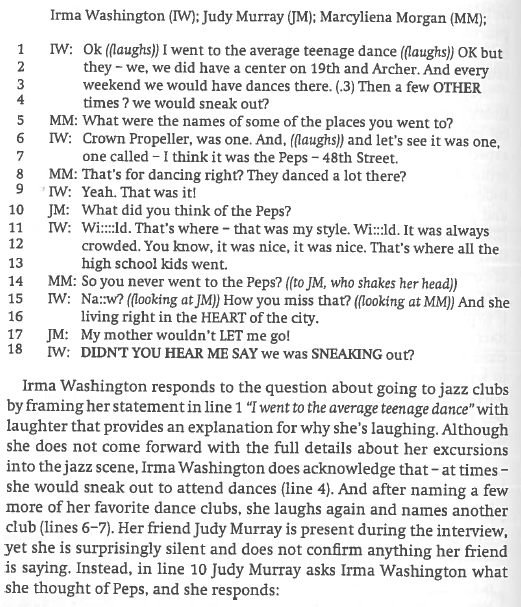
     Morgan transcription

    Morgan chose to highlight only a few non-verbal signs to make her argument about the meanings of this conversation that were indirectly implied rather than directly stated (eg., noting instances of laughselongated vowels, eye contact, head shaking, and loud talking. Meanwhile, the numbered lines make it easier to refer readers to specific parts of the interaction.


    To Try Your Hand at Transcribing:

    Make sure to number your lines (either by using your word processor's number lines feature, or by manually numbering the utterances). For ease of reading, make sure to break up the interaction by speaker and utterance. Start a new speaker on a new line, and new utterances of one speaker on a new line. Select your transcription symbols from this chart adapted from Jefferson and Gumperz and Berlenz:

    Symbol

    Name

    Use

    [ text ]

    Brackets

    Indicates the start and end points of overlapping speech.

    (1.5)

    Timed Pause

    A number in parentheses indicates the time, in seconds, of a pause in speech.

    (.)

    Micropause

    A brief pause, usually less than 0.2 seconds.

    .

    Period

    Indicates falling pitch.

    ?

    Question Mark

    Indicates rising pitch.

    ,

    Comma

    Indicates a temporary rise or fall in intonation.

    -

    Hyphen

    Indicates an abrupt halt or interruption in utterance.

    {f}

    Brackets

    Indicates that the enclosed speech was delivered faster than usual for the speaker. (G and P)

    {s}

    Brackets

    Indicates that the enclosed speech was delivered more slowly than usual for the speaker. (G and P)

    {hi}

    Brackets

    Indicates that the enclosed speech was delivered at a higher pitch than usual for the speaker. (G and P)

    {lo}

    Brackets

    Indicates that the enclosed speech was delivered at a lower pitch than usual for the speaker. (G and P)

    * word

    asterisk

    Indicates prominence or emphasis on the syllable (G and P)

    ** word

    asterisk

    Indicates extra prominence or emphasis on the syllable (G and P)

    ~ word


    Indicates fluctuating intonation over a word or syllable (G and P)

    ° word

    Degree symbol (option 0)

    Indicates whisper or reduced volume speech.

    ALL CAPS

    Capitalized text

    Indicates shouted or increased volume speech.

    wo:::rd

    Colon(s)

    Indicates prolongation of a syllable.

    (hhh)


    Audible exhalation

    (.hhh)


    Audible inhalation

    ( text )

    Parentheses

    Speech which is unclear or in doubt in the transcript.

    (( italic text ))

    Double Parentheses

    Annotation of non-verbal activity.

    Writing, Writing, Writing...for social change

    Ethnography is challenging, time consuming work. So why am I drawn to ethnography as a scientific method? What compels me (and hopefully you...